
Explore Oregon Wines: Wineries | Varietals | AVAs | Cellar 503 Selections
High Pass Winery 2024 Scheurebe
Elevating the Taste of Home
Dieter Boehm grew up in Beierfeld in southern Germany’s Ore Mountains. His father owned a restaurant there, which helped him develop an appreciation for wine early in life.
Unfortunately, Beierfeld was behind the Iron Curtain during Dieter’s younger years. At the age of 25, disillusioned with the East German system, Boehm and a friend escaped across the East German-Czech Republic border and traveled through Austria on their way to West Germany.
Dieter landed in Eugene in 1979, working at a Christmas tree farm and then planting trees for a cooperative (over 100,000 in his career). While living in Eugene, he realized how similar the area’s climate was to Heidelberg, the last place he lived in Germany. He knew the areas along the Neckar River near Heidelberg had vineyards, so why not here in his new home?
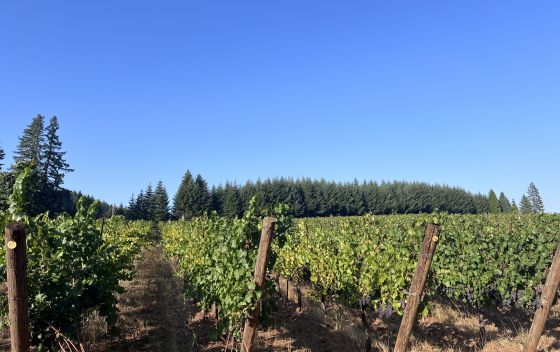
On a drive up High Pass Road one summer, Dieter spotted a steep, south-facing hillside covered in golden grasses. That was the precise moment he said “This is it.” He purchased the property for his estate vineyard on High Pass Road in 1984. Vines were planted the following year. After several years of selling his fruit to other wineries, Dieter released his first commercial wine from the 1994 vintage. Today, approximately 80% of the fruit is sold to wineries as large as King Estate in Eugene and as small as Helioterra Wines in Portland.
Cellar 503 Tasting Notes
High Pass Winery, Junction City, Oregon
2024 Scheurebe
A brand new grape variety to the Cellar 503 family!
Eight miles west of Junction City, a half hour’s drive from Eugene, is the modest, unassuming High Pass Winery with its rows of vines descending dramatically down steep hillsides. Boehm planted these vines in 1985 with samsonited cuttings from Germany.
When produced from fully ripe grapes, Scheurebe wines are dominated by rich blackcurrant aromas supplemented by grapefruit. Well-made dry Scheurebe wines can be quite full-bodied, but dry wines made from not fully ripe grapes tend to be dominated by the grapefruit component, and display it in an aggressive manner which makes for a clumsy, unattractive wine. Scheurebe therefore tends to be easier to use for sweet wines made from grapes that are fully ripe, overripe or affected by noble rot. Well-made sweet Scheurebe wines can show intense aromas of blood grape and honey.
It has been pointed out that Scheurebe retains quite a bit of Riesling character, although it is somewhat less acidic and can tend to be more clumsy. Just as Riesling, its wines tend to show terroir variation, and it has been called the single new breed variety of German origin that deserves serious attention for the quality of its wines.
180 cases produced
BACK TO SCHOOL
Scheurebe (German pronunciation: shoy-reba) or Sämling 88 is a white wine grape variety.
It is primarily grown in Germany and Austria, where it often is called Sämling 88 (English: Seedling 88), and some parts of the New World. Scheurebe wines are highly aromatic, and the variety is often used for sweet wines, although dry Scheurebe wines have become more common in Germany.
Scheurebe was created by German viticulturalist Dr. Georg Scheu (1879–1949) in 1916, when he was working as director of a grape-breeding institute in Alzey in Rheinhessen, by crossing Riesling with an unknown wild vine. According to the German grape-breeder Helmut Becker, Scheu's purpose was to create a superior version of Silvaner, with more aroma and greater resistance to frost damage and chlorosis. It was long assumed that Scheurebe was Silvaner x Riesling, but DNA analysis in the late 1990s ruled out Silvaner as a parent, while confirming Riesling as the father. It is known that Scheu was working on wild vines, so it is possible that a misidentification of the cross took place. According to official Austrian sources it is in fact a cross between Riesling and Bouquet Blanc (Bukettraube).
Seedling (in German Sämling) number 88 was simply Scheu's serial number for the vine plant selected for its properties. It was named in Scheu's honour in 1945. The Rebe suffix is simply the German word for vine. Scheurebe received varietal protection and was released for general cultivation in Germany in 1956, after Scheu's death.
A Cellar 503 selection in September 2025, Back to School Lower Long Tom | Scheurebe


